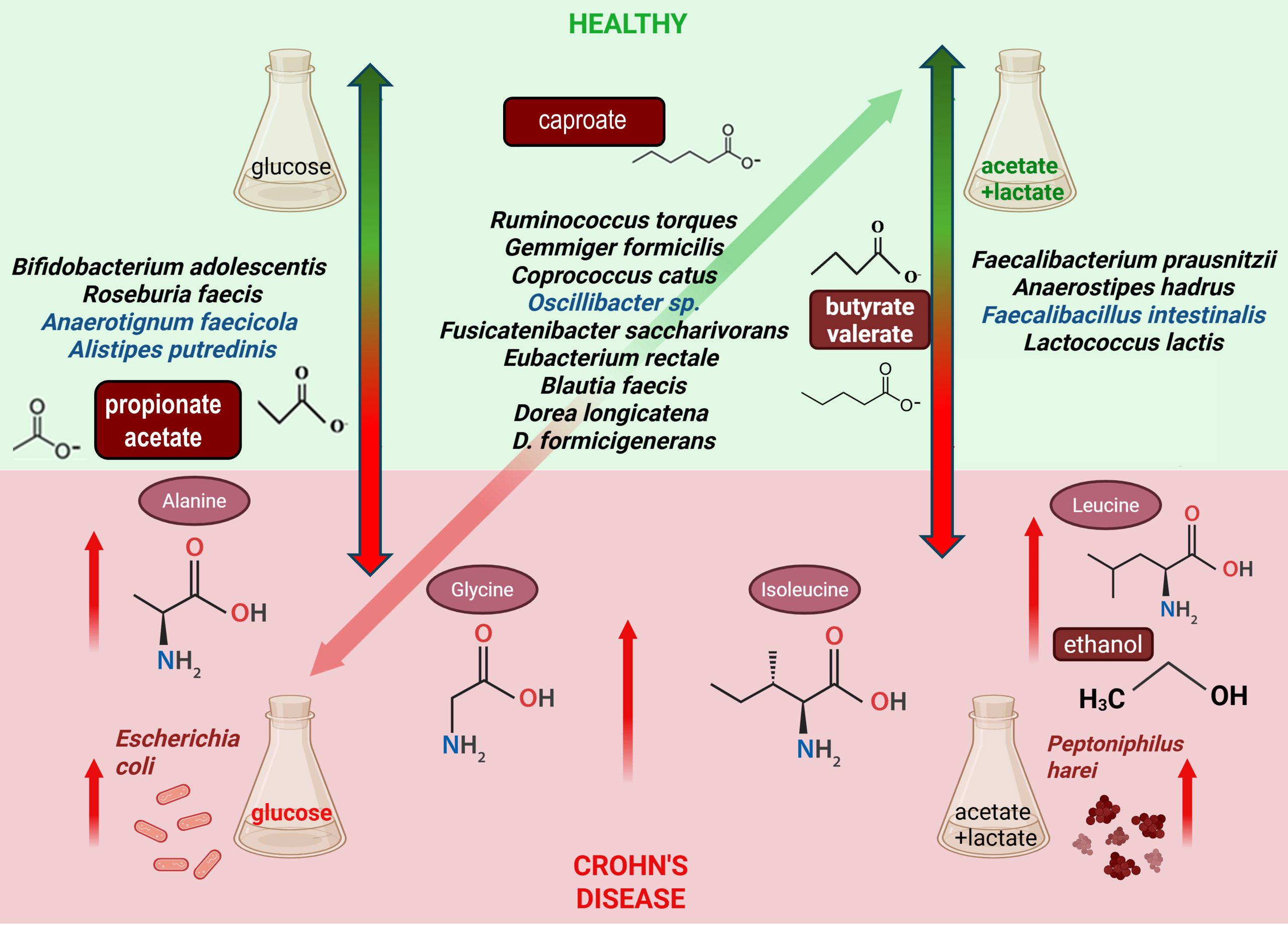
Patients with Crohn’s disease present abnormalities in the fermentation patterns of fecal microbiota
Research conducted by Dr. hab. Anna Sikora and Dr. Eng. Anna Detman-Ignatowska from the Laboratory of White Biotechnology, in collaboration with scientists from the University of Arizona and the University of Rzeszów, has demonstrated that the fermentation patterns of simple organic compounds (glucose, lactate, and acetate) displayed by the fecal microbiota of patients with Crohn’s disease (CD) differ from those observed in healthy individuals. The study showed that the microbiota of healthy individuals efficiently converts lactate and acetate into butyrate, a compound essential for proper intestinal function. In contrast, this metabolic pathway was markedly impaired in most CD patients. This was accompanied by reduced production of other organic acids, including valerate and caproate, and increased production of ethanol and certain amino acids. Importantly, these differences can be observed under standardized laboratory conditions (in vitro), without the need to recreate the complex intestinal environment.
These findings highlight the potential of analyzing the fermentation activity of fecal microbiota as a tool for investigating microbiome dysfunction. In the future, this approach may contribute to supporting the assessment of microbiome disturbances and the monitoring of strategies aimed at restoring its balance, although further research and validation are needed.
Read more in the publication: https://doi.org/10.1186/s12934-026-03052-4